
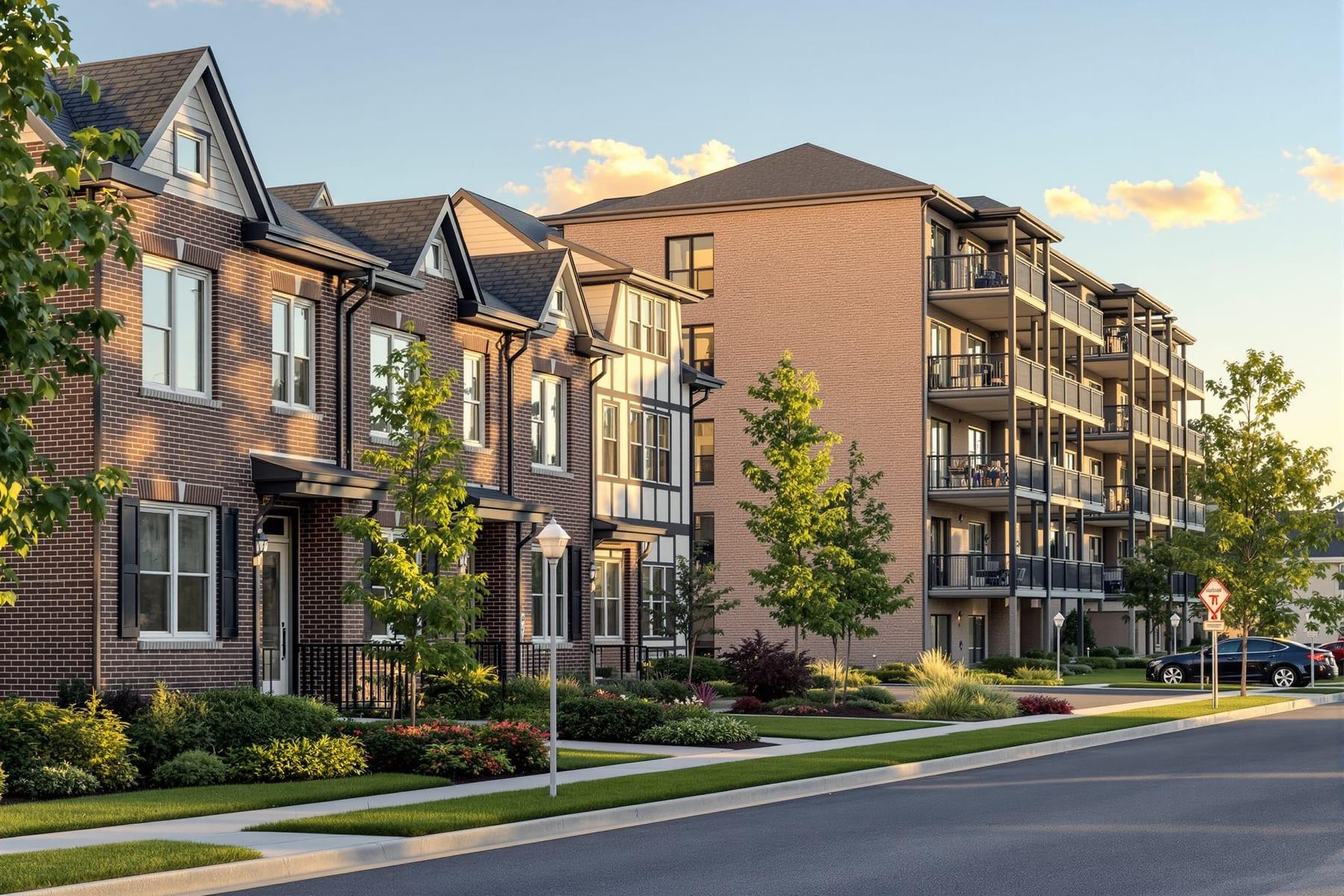
Condo vs townhouse: what you actually own, what the HOA costs, and how each one gets financed
The condo vs townhouse question looks like a question about architecture, and it is really a question about ownership. What you legally own decides who fixes the roof, what insurance you buy, and how much paperwork your lender needs about the association. Here is the comparison the way an underwriter sees it, for buyers from Crystal Lake to Appleton.
 Home State Bank mortgage teamCrystal Lake, IL · Appleton, WI · NMLS 478452Updated September 14, 20267-minute read
Condo vs townhouse: the ownership difference
In a condominium you own the inside of your unit, plus a shared interest in everything else: the land, the roof, the exterior walls, the hallways, the parking lot. The association maintains and insures those common elements. Illinois condominiums are created under the Condominium Property Act, and Wisconsin condominiums under Chapter 703 of the state statutes.
In a typical townhouse you own the structure and the lot it sits on, and an association owns and maintains shared areas such as private streets, ponds, or a clubhouse. Lenders call that arrangement a planned unit development, or PUD. You are usually responsible for your own roof and exterior unless the association's documents say otherwise.
Here is the catch: the listing label describes the building style, not the legal form. A townhouse-style home can legally be a condominium, and that happens in our markets. The declaration and the legal description decide which rules apply, so ask your agent before you write an offer.
Side by side
A general comparison. Every association writes its own rules, so treat this as the usual pattern, not a promise about a specific community.
| Condo | Townhouse (PUD) | |
|---|---|---|
| What you own | The interior of the unit and a share of the common elements | The home and its lot, plus membership in the association |
| Exterior and roof | Usually the association | Usually the owner, unless the documents assign it to the association |
| HOA dues | Often higher, because they cover the building, master insurance, and reserves | Often lower, covering common areas and sometimes lawn and snow |
| Your insurance | HO-6 unit owner policy | HO-3 homeowner policy in most cases |
| Lender's project review | Required for most attached condo projects | Waived by Fannie Mae for PUD projects |
| FHA and VA | The project generally must be approved, or the unit must qualify for FHA single-unit approval | No condo project approval needed when the home is not legally a condo |
| Special assessment exposure | Higher, since owners share the cost of the whole building | Lower, limited to the shared areas |
How HOA fees and special assessments count in your debt-to-income ratio
HOA fees are part of your housing payment for qualifying purposes. Fannie Mae's definition of monthly housing expense includes owners' association dues and special assessments, right alongside principal, interest, taxes, and insurance. Dues do not buy equity, but they take up room in your debt-to-income ratio exactly the way a loan payment does.
A rough illustration: at an example rate of 6.5% on a 30-year fixed loan, $300 a month in dues takes up about the same room in your budget as $47,000 of loan amount. That does not make a condo a bad deal, because those dues may be paying for a roof, siding, snow removal, and insurance you would otherwise pay for yourself. It does mean two homes at the same price can qualify very differently.
Special assessments are one-time or multi-year charges for big projects the reserves cannot cover, such as roofs, parking lots, or elevators. Ask for the current budget, the reserve balance, the most recent reserve study if there is one, and the last year of meeting minutes. Minutes are where upcoming assessments show up first.
Condo financing: the project review, and the FHA and VA lists
With condo financing the lender underwrites two things: you and the building. For most attached condos, a loan headed to Fannie Mae or Freddie Mac requires a project review covering the association's budget and reserves, insurance, delinquent dues, litigation, commercial space, and how many units one owner holds. A project that passes is called warrantable. Fannie Mae waives the project review for detached condo units, for two- to four-unit projects, and for PUDs, which is one reason a townhouse mortgage tends to be simpler.
A project that fails is non-warrantable, and most lenders cannot finance a unit there. As a portfolio lender we can review the association ourselves and, in many cases, keep the loan on our own books. Our guide to non-warrantable condo loans explains the tests and how that review works.
Government loans add another step. FHA insures condo loans in FHA-approved projects, which you can search on HUD's condominium lookup, and also offers single-unit approval for a unit in an unapproved project that meets its conditions, including at least five units in the project and a cap on the share of FHA loans in the building. VA requires the condo project to be on its accepted list, which is searchable on the VA condo report. A townhouse that is legally a PUD does not need either approval.
Insurance: HO-6 vs HO-3
A condo association carries a master policy on the building and common areas. You carry an HO-6 policy for what the master policy does not cover: your belongings, liability, and, depending on the master policy, the interior finishes, cabinets, and fixtures. Fannie Mae requires an HO-6 policy when the master policy does not cover the unit's interior, or when the master policy has a per-unit deductible, in an amount sufficient to restore the unit. Ask your insurance agent about loss assessment coverage as well, which helps if the association bills owners for a claim deductible.
A townhouse owner who owns the structure normally buys an HO-3 homeowner policy covering the building itself, the same as a detached house. The premium is usually higher than an HO-6, which offsets part of the difference in dues. If a townhouse community is legally a condominium, the HO-6 and master policy arrangement applies instead.
Resale, and what we see in local developments
Resale follows financing. The more loan types a buyer can use on your unit, the more buyers you have when you sell. A condo in a project that is not FHA or VA approved, or that becomes non-warrantable because of a lawsuit or thin reserves, has a smaller buyer pool until the problem is fixed. Townhouses avoid most of that, though they share walls and, often, rental limits and exterior rules.
In Crystal Lake and Algonquin, attached homes are often part of larger associations with professional management. In Appleton and Neenah we also see smaller, self-managed associations, sometimes just a handful of buildings. Small is not bad, and dues are often lower, but reserves can be thin and one large repair can mean an assessment. The documents tell you more than the listing photos in either state. We read association budgets every week and are glad to look at one with you before you make an offer.
Questions people ask
- Is it harder to get a mortgage for a condo than a townhouse?
- Usually a little, because the lender also has to review the condo project. A townhouse that is legally a planned unit development skips that project review under Fannie Mae's rules. Your own qualification works the same either way.
- Do HOA fees count toward my debt-to-income ratio?
- Yes. Association dues and special assessments are part of the monthly housing expense lenders use to qualify you, along with principal, interest, taxes, and insurance.
- Can I use an FHA or VA loan to buy a condo?
- Yes, if the project is on the FHA or VA approved list, or, for FHA, if the unit qualifies for single-unit approval. Check both lists early, because approval belongs to the project, not the buyer.
- What is the difference between HO-6 and HO-3 insurance?
- An HO-6 policy covers a condo unit's interior, your belongings, and liability, and works alongside the association's master policy. An HO-3 policy covers an entire home and structure you own, which is the usual setup for a townhouse or detached house.
- Which holds its value better, a condo or a townhouse?
- It depends on the location and the health of the association more than the label. A well-run association with solid reserves, in a project eligible for all the major loan types, tends to protect resale value in either form.
Sources
- Fannie Mae Selling Guide B4-2.1-01, General Information on Project Standards
- Fannie Mae Selling Guide B3-6-03, Monthly Housing Expense for the Subject Property
- Fannie Mae Selling Guide B7-3-04, Property Insurance Requirements for Individual Units in a Project Development
- HUD: FHA Condominiums (approved project lookup and single-unit approval)
- VA: Condo Report (approved condominium search)
This article is general information, not financial, tax, or legal advice, and not a commitment to lend. Program terms, limits, and rates change; confirm current figures with a loan officer. Home State Bank, N.A. NMLS 478452. Member FDIC · Equal Housing Lender.